Frugality with Value: Biomarkers, Food Assetization and the making of Entrepreneurial Science Stathis Arapostathis, Assoc. Prof., Philosophy & History of Science Dept., National & Kapodistrian University of Athens [remote presentation] […]


Frugality with Value: Biomarkers, Food Assetization and the making of Entrepreneurial Science Stathis Arapostathis, Assoc. Prof., Philosophy & History of Science Dept., National & Kapodistrian University of Athens [remote presentation] […]
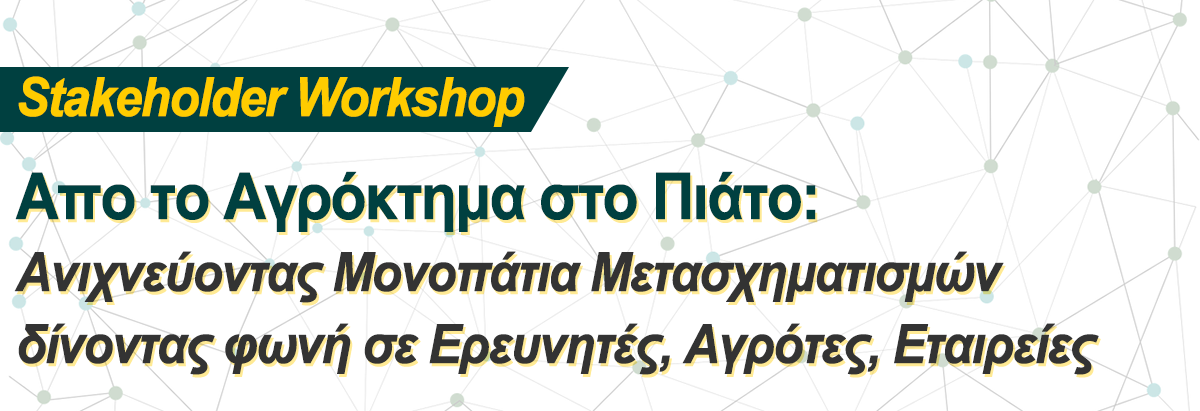
Το ερευνητικό έργο “Διαμορφώνοντας το περιβάλλον και τη διατροφή: Κρίσιμα τεχνο-επιστημονικά δίκτυα και ο αγρο-διατροφικός τομέας στην Ελλάδα” (CONEF) διοργανώνει ημερίδα με ζωντανά εργαστήρια την Πέμπτη 26 Ιανουαρίου 2023 (16:30-21:30)
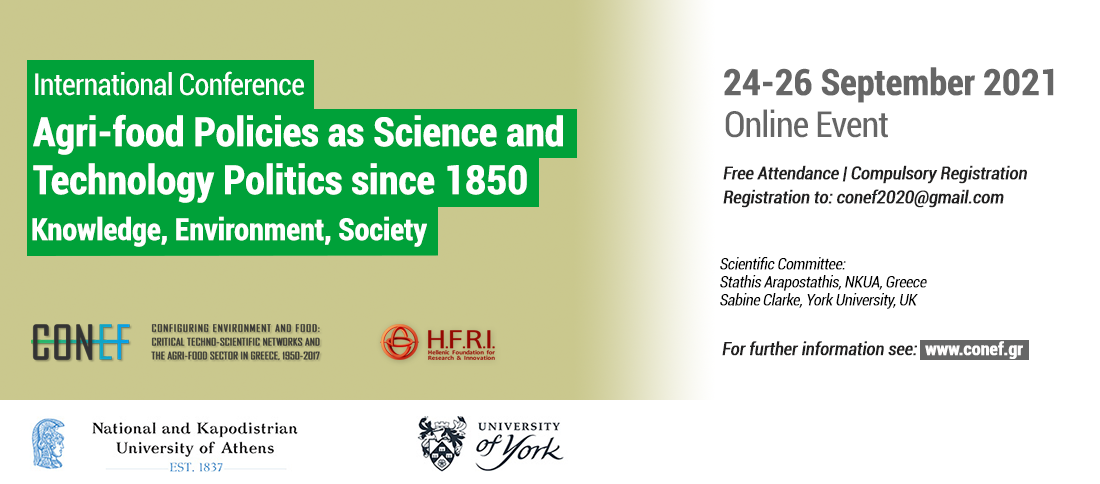
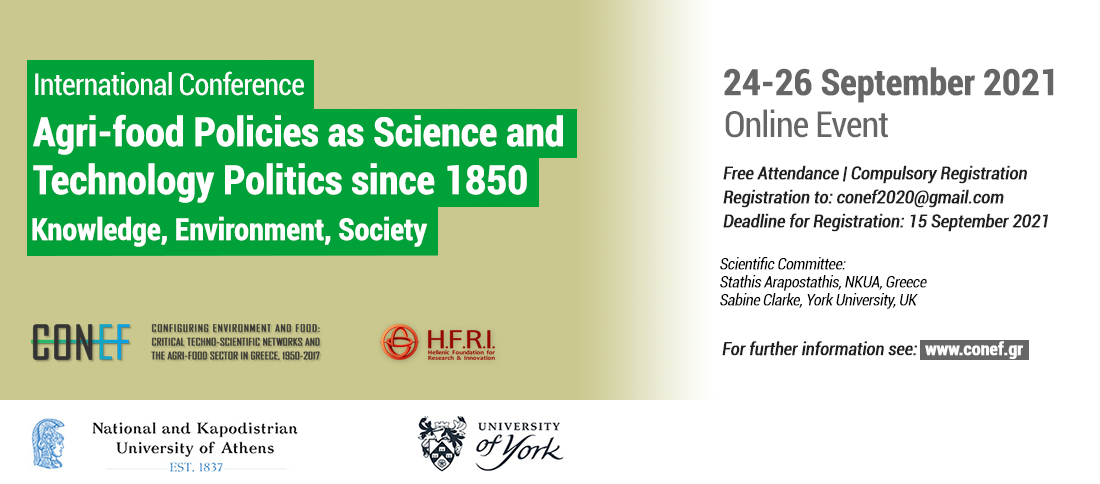
 Recent studies in the fields of energy and environment studies and Science, Technology and Society (STS) studies have emphasized the analysis of the agri-food sector and food chain in relation to their role in shaping energy consumption, water management and environmental impact. The environment is understood as a material constitution of animal and plant organisms, which is often impacted by particular infrastructures, practices and policies. The intensification of the production and use of new innovations and technologies in producing animal and plant organisms has further increased the burden on the environment and raised the level of greenhouse gas emissions. Industrial-scale agriculture and the science-based agri-food sector are characterized by intensive energy and water consumption. Agriculture and the agri-food sector contribute substantially to greenhouse gas emissions and pollutants. The harmful effects on the environment from the green revolution of the 1960s and 1970s, and the subsequent paradigm with the emphasis on science-based, intensive and industrialized agriculture, have been stressed and pointed out by agronomists, social scientists and actors from civil society. Environment-shaping activities exist at each step of the food chain (i.e. production, processing and consumption) and the establishment of sustainability in the agri-food sector is a major societal challenge waiting to be tackled. We have identified that in modern societies there has been an analytical and epistemological fragmentation of the modes of production and the modes of consumption through the medicalization of the discourse about the diet. The gap between the modes of production and those of consumption in terms of public and scientific discourses are present both in the countries of the Global North and the Global South in different and distinct ways in each case. Food and agriculture are facing an increasing number of “grand challenges”: climate change, energy and water resource depletion, emerging diseases and antimicrobial resistance. They increase the uncertainty about the future development of agriculture, making it difficult to see how the increasing demand for food and other bio-based materials can be met in a sustainable way.
See more about the project ⇀