Session: Responsible Research and Innovation and Animal-based Food Systems: From the Lab to the Meat Production Unit (Sun, December 11, 12:30 to 2:30am EET) Chair/Session Organizer: Stathis Arapostathis, National and […]


Session: Responsible Research and Innovation and Animal-based Food Systems: From the Lab to the Meat Production Unit (Sun, December 11, 12:30 to 2:30am EET) Chair/Session Organizer: Stathis Arapostathis, National and […]
Material Entanglements, Path dependencies and the Quest of Sustainability in meat production in Greece Stathis Arapostathis Contemporary policy priorities of EU Farm to Fork strategy have placed animal welfare centrally
Transformation, Adaptive Capacity and Resilience in the Greek agrifood regime during the pandemic S. Arapostathis1, I. Theodorakopoulou2, S. Alexakis1, C. Iliopoulos2 1National and Kapodistrian University of Athens, Dept. of History
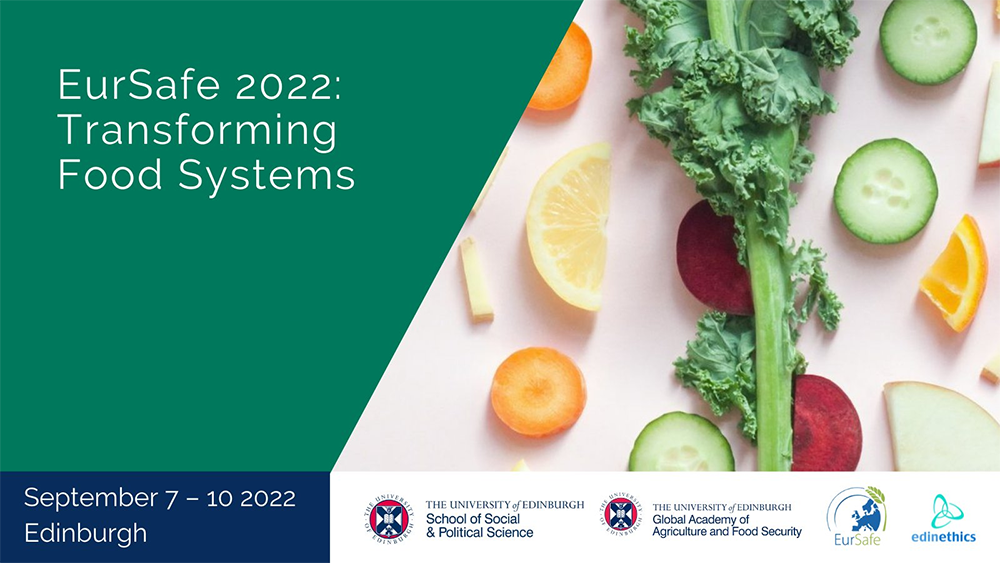
EurSafe 2022: Transforming Food Systems, 7-10 September, 2022, Edinburgh, UKRead More »

Entangling the nexus of water with food production: Seeds, fertilizers and water management in post-war Greece Alexakis Sotiris and Arapostathis Stathis The post-war agricultural policies in Greece are characterized by
Entangling Minerals, Chemicals and Water in Greek agriculture of the 20th century Alexakis Sotiris and Arapostathis Stathis The paper’s aim is to provide a historical reconstruction of the entangled history
Fishing in toxic waters?: Transitioning technoscience, practices and the environment in Greek aquacultures Stathis Arapostathis and Konstnantinos Vattes, National and Kapodistian University of Athens The paper studies the co–production (Jasanoff,
4S Annual Meeting, 6-9 October, 2021, Toronto, CanadaRead More »
Challenging incumbency by integrating radical pathways: Governing challenges, interests and socio–materialities in Agri–food transformations Organizers: Kostas Vattes and Stathis Arapostathis, National and Kapodistrian University of Athens Incumbent agri–food socio–technical systems

Part of the Tensions of Europe Digital Workshop Festival (28 June – 2 July 2021, https://shtwebinars.nl) Organizers Frank Veraart: Eindhoven History Lab, Dept. of Industrial Engineering and Innovation Sciences, Eindhoven
Entangling Technological Infrastructures, Material Flows and Modernities (July 2th, 2021)Read More »
Agri-food Regime Dynamics, Technoscience and Sustainability Transition Politics in Greece Alexandros Vakoulas, Sotiris Alexakis, Kostas Vattes, Stathis Arapostathis The agri-food socio-technical system faces increasing challenges during the last decades due
Sowing varieties of wheat, oil olives and sustainability: Regime dynamics and transition politics in Greece
 Recent studies in the fields of energy and environment studies and Science, Technology and Society (STS) studies have emphasized the analysis of the agri-food sector and food chain in relation to their role in shaping energy consumption, water management and environmental impact. The environment is understood as a material constitution of animal and plant organisms, which is often impacted by particular infrastructures, practices and policies. The intensification of the production and use of new innovations and technologies in producing animal and plant organisms has further increased the burden on the environment and raised the level of greenhouse gas emissions. Industrial-scale agriculture and the science-based agri-food sector are characterized by intensive energy and water consumption. Agriculture and the agri-food sector contribute substantially to greenhouse gas emissions and pollutants. The harmful effects on the environment from the green revolution of the 1960s and 1970s, and the subsequent paradigm with the emphasis on science-based, intensive and industrialized agriculture, have been stressed and pointed out by agronomists, social scientists and actors from civil society. Environment-shaping activities exist at each step of the food chain (i.e. production, processing and consumption) and the establishment of sustainability in the agri-food sector is a major societal challenge waiting to be tackled. We have identified that in modern societies there has been an analytical and epistemological fragmentation of the modes of production and the modes of consumption through the medicalization of the discourse about the diet. The gap between the modes of production and those of consumption in terms of public and scientific discourses are present both in the countries of the Global North and the Global South in different and distinct ways in each case. Food and agriculture are facing an increasing number of “grand challenges”: climate change, energy and water resource depletion, emerging diseases and antimicrobial resistance. They increase the uncertainty about the future development of agriculture, making it difficult to see how the increasing demand for food and other bio-based materials can be met in a sustainable way.
See more about the project ⇀